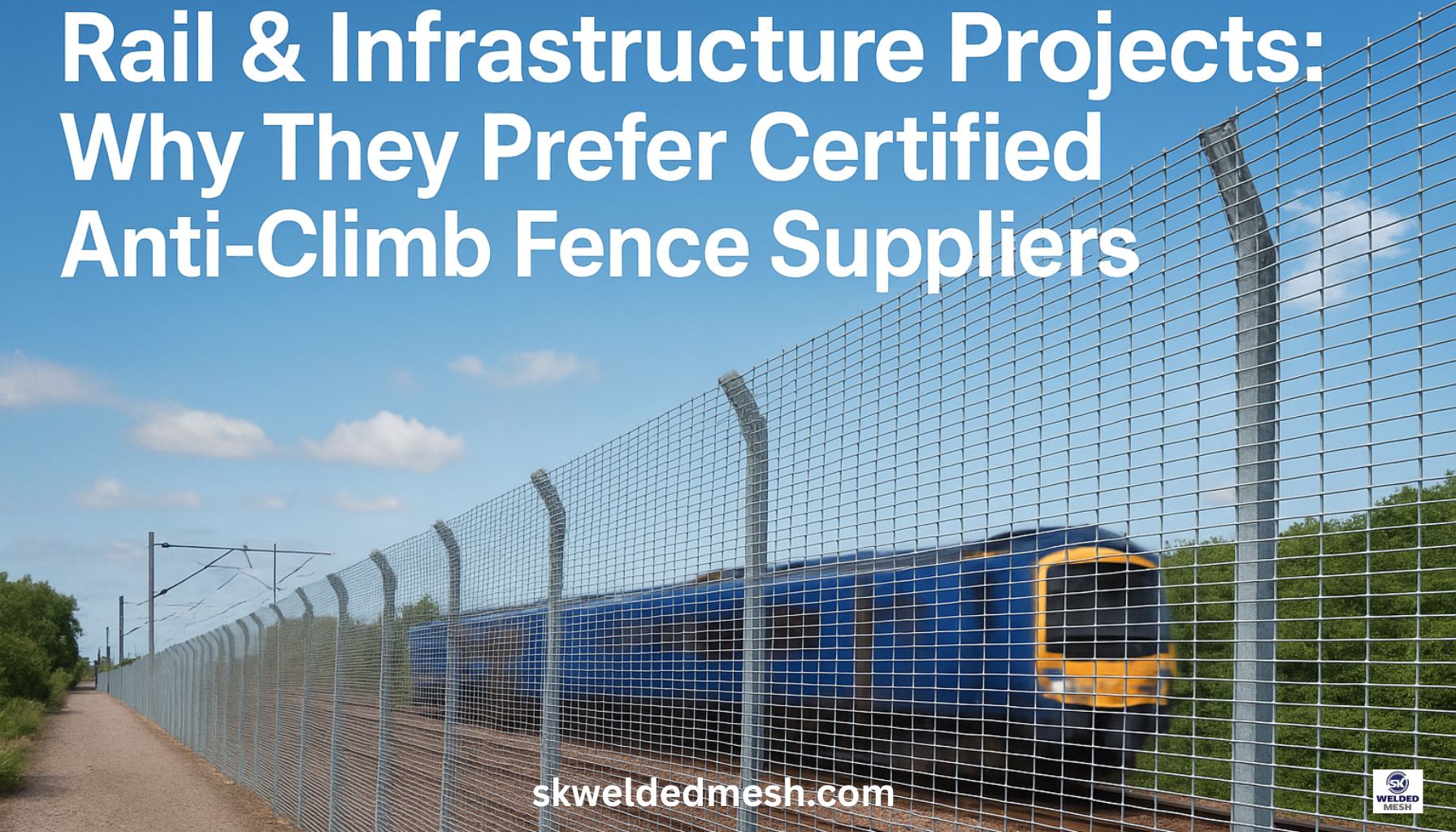
Train movement depends on more than tracks and signals. Every corridor, yard, and passenger zone runs parallel to one unseen layer of protection—fencing. As infrastructure grows faster, taller, and smarter, the need for precision-built fencing has become more urgent. More contractors now lean toward certified anti-climb fences mesh systems, especially in rail builds where mistakes affect public safety. These systems don’t just close off an area. They shape how safely people, trains, and equipment move around it.
Let’s look at why your project may need it long before the track is ready.
Rail infrastructure runs on documentation. Every bolt, beam, and barrier is signed off against spec sheets, quality checks, and approval workflows.
Certified anti-climb fences mesh helps streamline this. You get materials that meet regulatory grades and test results that match what engineers need.
Our mesh panels are often pre-tested for weld shear, corrosion resistance, and tension under field conditions.
For one depot fencing project, having that documentation in place helped the team move from design approval to site install without added technical queries.
Timelines in rail projects rarely allow for on-site improvisation. Mesh panels that retain shape during lifting, handling, and mounting support faster and more reliable installation.
Added bends improve rigidity without adding weight. That balance reduces flexing during post alignment and lowers the chance of mid-install correction.
Crews using pre-sized mesh panels from our supply inventory have trimmed hours off setup. With clearer labeling and panel numbering, teams moved section to section without confusion, even on stretches with curves and gradients.
Fencing is part of the safety plan, but so is visibility. CCTV coverage, patrols, and even drone surveys rely on sightlines across track zones and substations.
Mesh fencing supports this without creating blind corners or solid blocks.
We’ve worked with design consultants who mapped surveillance angles before finalizing fencing specs. With anti-climb mesh fences, they maintained open views while locking down access points.
The result was better coordination between security and infrastructure teams, especially in dual-use zones like station yards.
Projects that move thousands of people daily cannot afford uncertainty at the fence line.
Anti-climb mesh plays a direct role in shaping how safe, efficient, and cost-stable a corridor stays after handover.
We’ve worked with rail contractors, EPC firms, and state-backed developers to supply mesh that ticks all the boxes, from spec sheets to on-ground performance.
If your infrastructure build demands reliability that lasts beyond day one, our mesh can be built around that goal.
It is pleasure working with well informed team of S.K.Weldedmesh Pvt. Ltd.,their expertise has brought results to our projects. They understand the customer’s requirements and priorities. A quality product is always appreciated in our field of work.
For years now we have trusted SK Welded products for a range of construction projects I have worked on. A good Mesh Manufacturing company in West Bengal that doesn’t just talk about quality but actually delivers it. Plus, their pricing is equally appropriate, which makes working with them an obvious and preferred choice.


