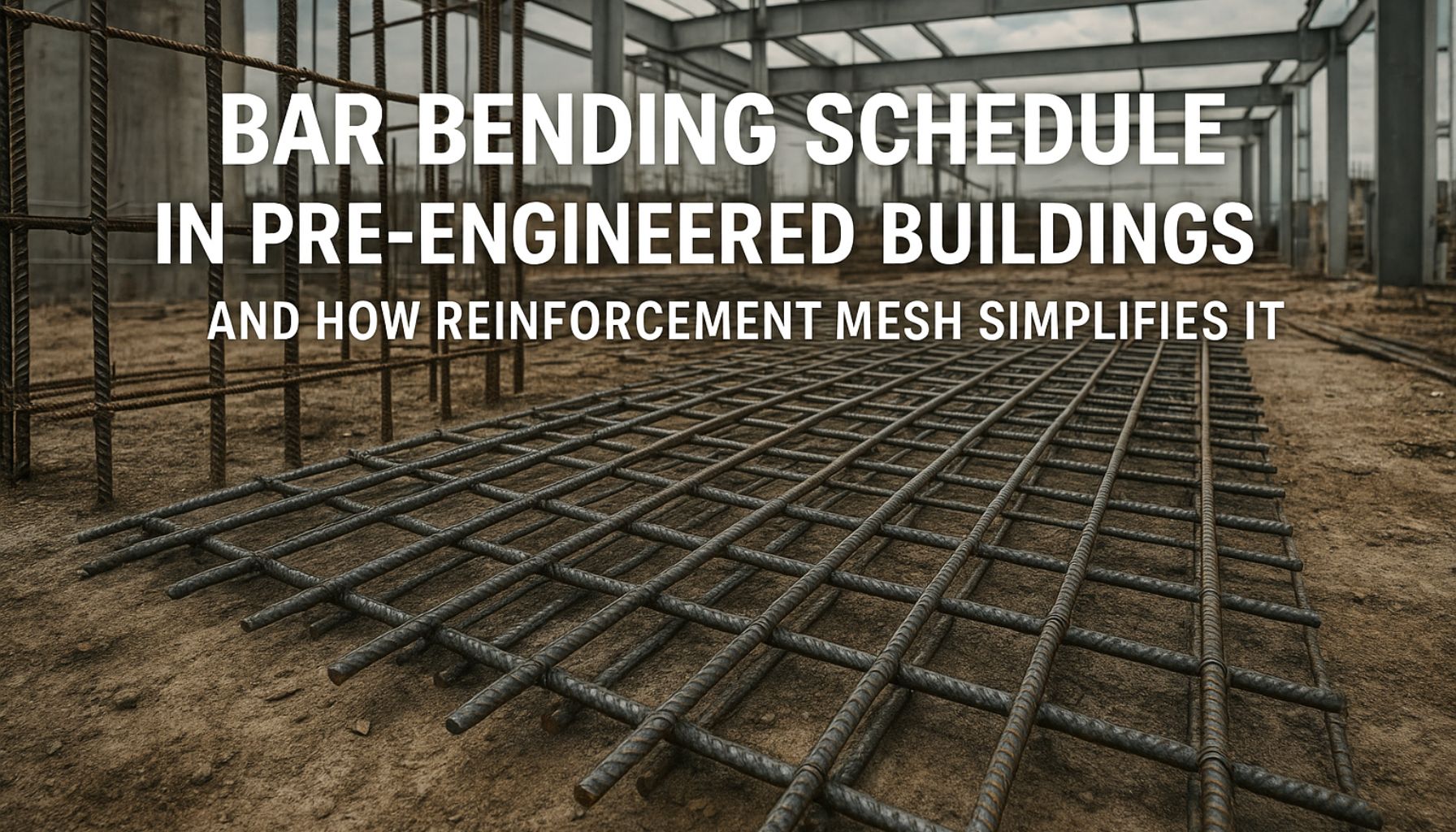
Some site teams move fast, but stay stuck on the basics. Bar cutting, rechecking overlaps, wrestling with schedules that don’t match the drawings… Most of it starts with the way BBS is handled. In pre-engineered buildings, these issues get amplified. Because the entire build hinges on prefab parts showing up, locking in, and staying aligned. Your steel needs to behave. That’s where reinforcement mesh shifts the equation — less margin stacking, more clarity.
Let’s break down where the complexity lies and how mesh removes the friction.
BBS in conventional builds already takes time. But with PEBs, the complexity spikes. You’re not just dealing with beams and columns; you’re aligning with base plates, anchor bolts, and concrete pockets that arrive ready to fit. If your bar lengths run long, they clash with anchors. If you miss a bend angle, you delay the frame setting. Everything runs on clockwork. BBS here isn’t just paperwork. It’s the script for sequencing the entire job.
When bending bars manually, it’s common to over-bend and fix later. But in pre-engineered builds, that’s not a safe buffer; it’s a costly detour. Rework affects slab timelines, which in turn affects when structural steel can be placed. Mesh takes those calls out of the field. Each sheet arrives welded to spec, removing variables. No bar lists, no cutting yards and no rework files handed to the QS team.
One of the least-discussed challenges in BBS planning is working off approximations. Engineers often leave 10% room to account for lap length errors, starter bar anchorage, or poorly marked beam intersections. Mesh simplifies that guesswork. Since each panel follows standard sizing with fixed overlaps and cover clearances, design teams get to model the structure more tightly. Which means tighter control over steel quantity and fewer surprises during billing.
In pre-engineered builds, slab pours often serve as the foundation for bolted connections. That means your concrete timeline dictates your steel assembly. Loose rebar causes delays in these pours, either from cutting lags or incorrect placement. Mesh panels reduce pour prep dramatically. For a logistics warehouse we supported, switching from rebar to reinforcement mesh on footings alone trimmed two whole days from the pour sequence. The anchors hit the exact elevation, and the structure above stayed on track.
Rework in PEBs takes a bigger bite than in conventional builds. That’s because any delay to RCC affects when and how the prefab steel gets installed. You lose more than hours; you lose the crane, the slots, and sometimes the structural guarantee from the vendor. Using mesh helps lock down accuracy earlier in the process. Welds are tested. Sheet sizes are mapped. When they arrive, they’re ready to place, and the team moves forward instead of circling back.
Mesh doesn’t just cut time. It removes small inefficiencies that typically slip under the radar. Billing sheets become simpler because steel quantities follow a fixed format. Anchoring details stay cleaner, since the uniform panel layout avoids bar congestion around base plates. During inspections, reinforcement appears consistent where spacing holds true, cover stays even, and checks move faster. Handling also improves across the board, with tighter stacking, easier lifting, and less confusion over which zone gets what. Every one of these details adds up, especially when working against a prefabricated schedule. Mesh helps replace last-minute corrections with rhythm and repeatability.
Pre-engineered buildings are designed for speed, but the materials supporting them need to match that pace. Reinforcement mesh removes the unknowns from BBS, keeps sequencing predictable, and helps teams spend more time building and less time fixing. We’ve supported contractors, consultants, and developers in adapting mesh to fit their workflows, without overhauling their processes. If your next PEB needs steel that keeps up with the structure, that conversation starts long before the columns arrive.
It is pleasure working with well informed team of S.K.Weldedmesh Pvt. Ltd.,their expertise has brought results to our projects. They understand the customer’s requirements and priorities. A quality product is always appreciated in our field of work.
For years now we have trusted SK Welded products for a range of construction projects I have worked on. A good Mesh Manufacturing company in West Bengal that doesn’t just talk about quality but actually delivers it. Plus, their pricing is equally appropriate, which makes working with them an obvious and preferred choice.